Next Meeting: March 10th, 2026

Please join us on Tuesday, March 10th at our new, earlier start time of 6:00 pm for the next bi-monthly meeting of the Santa Monica Mountains Task Force. We meet once every two months, generally on a Tuesday evening. All are welcome!

Call in to meet fellow activists and volunteers, hear about current issues affecting the Santa Monica Mountains, and discover ways to support our ongoing mission to preserve and protect them.

SUBSCRIBE TO OUR MAILING LIST (https://smmtf.org/mailing-list/) to receive the details of upcoming meetings. The agenda, location (on the Westside), and a Zoom link for remote attendees will be emailed to you 24-48 hrs in advance.

CA proposal to loosen restrictions on anticoagulant rodenticides

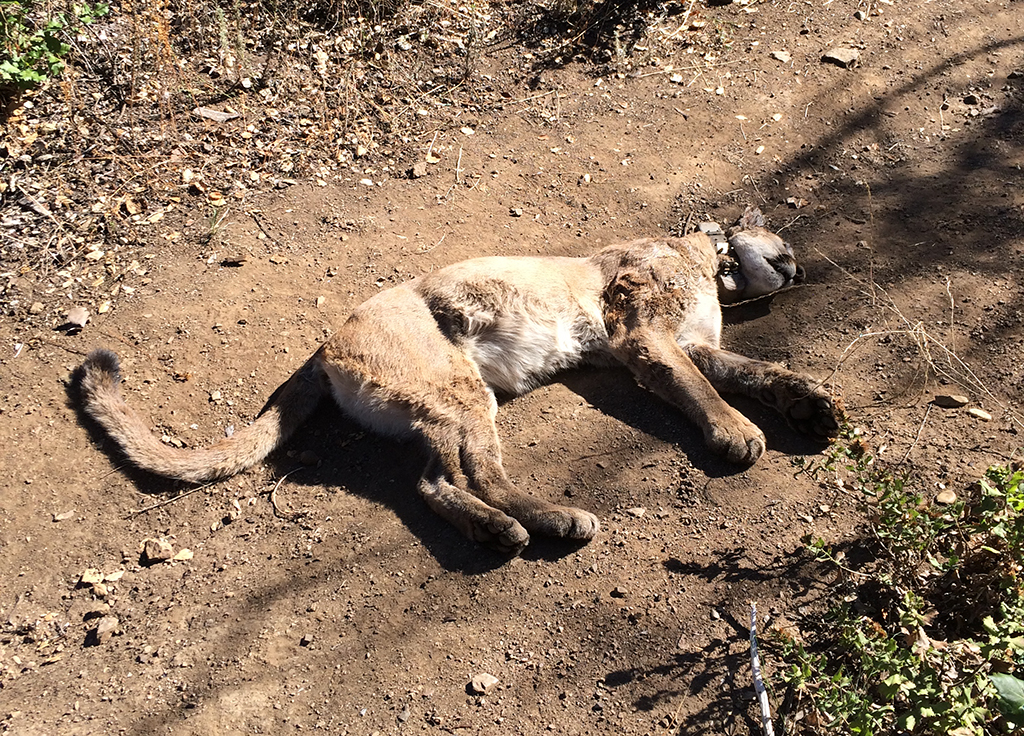
Untold numbers of anonymous California wildlife succumb to disease and death every year due to continued environmental exposure to rodenticide.

Despite evidence of escalating harm, the California Department of Pesticide Regulation’s current proposal would roll back existing restrictions on usage of the most toxic rat poisons. These rollbacks would allow increased rodenticide usage at more than 100,000 new locations statewide, including roadways, parks and wildlife areas.

Read the full Los Angeles Times op-ed by guest contributor Tony Tucci:

https://www.latimes.com/opinion/story/2026-01-13/rat-poisons-mountain-lions

Preliminary necropsy results indicated P-34 may have died in 2015 as a result of rodenticide poisoning | Image courtesy of National Park Service

Next Meeting: January 13th, 2026

Please join us on Tuesday, January 13th at 7:00 pm for the next bi-monthly meeting of the Santa Monica Mountains Task Force. We meet once every two months, generally on a Tuesday evening. All are welcome!

Call in to meet fellow activists and volunteers, hear about current issues affecting the Santa Monica Mountains, and discover ways to support our ongoing mission to preserve and protect them.

SUBSCRIBE TO OUR MAILING LIST (https://smmtf.org/mailing-list/) to receive the details of upcoming meetings. The agenda, location (on the Westside), and a Zoom link for remote attendees will be emailed to you 24-48 hrs in advance.

An update from the Chair – November 2025

If you are an environmentalist (or “tree-hugger”) like me, as I suspect most Sierra Club members are, you know these are tumultuous, distressing and trying times.

Every morning’s newspaper brings a new upset, a new outrage. I’d be surprised if our current president had ever even been to a national park, yet he wants to open them up to stripmining, resource exploitation and private-industry depredation. Last week they announced that, revoking President Biden’s order, they are opening up the Arctic National Wildlife Refuge to oil-drilling (remember Sarah Palin, “Drill Baby Drill”?), in the process threatening millions of caribou, polar bears and other animals. Even though none of the Big Oil companies even wants to bid on the leases (due to the expense, and backlash from the general public).

The Administration encouraged a Texas oil driller to drill off the Santa Barbara coast, even though the California Coastal Commission shut it down for numerous violations of the Coastal Act. I still remember in 1969, when I was 15, how the massive pipe-burst coated the Santa Barbara beaches with oil, killing thousands of seabirds. It filled the front pages for weeks and months.

One of our Sierra Club members with connections to the Interior Department recently reported that the Administration has identified the Santa Monica Mountains National Recreation Area (SMMNRA) as “woke”, and is on a mission to shut it down. Remember that the SMMNRA was authorized, and funded, by an Act of Congress. Our current government cares nothing about National Parks, or State Parks, or, for that matter, wilderness open space at all. And it is firing federal workers and laying off others, including national park employees and rangers, and shutting down the government to further its agenda.

So who is doing anything about this?

Fortunately, the Sierra Club for one. As well as a bunch of allied Earth Justice organizations. I urge everyone to contribute whatever you can afford to fund to support this fight.

We’re in the winter of an Ice Age, but it won’t last forever. In fact, yesterday’s elections showed a decisive backlash by the electorate against everything the Administration is pursuing. Keep up your courage and carry on, Sierra Clubbers!

Eric Edmunds, Chair
Santa Monica Mountains Task Force

Next Meeting: November 11th, 2025

Please join us on Tuesday, November 11th at 7:00 pm for the next bi-monthly meeting of the Santa Monica Mountains Task Force. We meet once every two months, generally on a Tuesday evening. All are welcome!

Call in to meet fellow activists and volunteers, hear about current issues affecting the Santa Monica Mountains, and discover ways to support our ongoing mission to preserve and protect them.

SUBSCRIBE TO OUR MAILING LIST (https://smmtf.org/mailing-list/) to receive the details of upcoming meetings. The agenda, location (on the Westside), and a Zoom link for remote attendees will be emailed to you 24-48 hrs in advance.

U.S. Army Corps of Engineers Expands Hazardous Tree Marking System, Clarifies Waiver Process

PRESS RELEASE
U.S. Army Corps of Engineers
March 6, 2025

In response to community feedback and a comprehensive review of hazardous tree removal procedures, the U.S. Army Corps of Engineers (USACE) has implemented updates to its tree marking system and clarified details regarding the newly available hazardous tree removal waiver.

To enhance transparency and improve processes, USACE has added two new color markings in addition to the existing blue dot, which signifies a tree that has been assessed and determined to be hazardous.

Blue Dot – Trees marked with a blue dot at the base and a barcode have been determined to be hazardous and are scheduled for removal.

Yellow Dot with Yellow Ribbon – Trees where a property owner has submitted a hazardous tree removal waiver will be marked with a yellow dot at the base and a yellow ribbon wrapped around the tree. The barcode will be removed, and this update will be cataloged in the contractor’s system to ensure the tree remains in place.

Brown Dot – If a tree is reassessed and determined to be non-hazardous by a higher-level ISA-certified arborist, it will be marked with a brown dot over the existing blue dot. The barcode will be removed, and this update will be recorded in the contractor’s tracking system, confirming the tree will not be removed.

The Waiver of Hazardous Tree Removal form is linked here and also available at recovery.lacounty.gov. Owners are encouraged to express their intent to waive tree removal during the 72-hour and 24-hour notification calls.

In response to community concerns, USACE has amended its waiver submission process. Property owners may now submit the Waiver of Hazardous Tree Removal via email or to the contractor during the 360-degree walkthrough, which is the last step before debris removal operations begin. Completed forms must be emailed to Eatoncallcenter@ecc.net for Altadena properties or Palisadescallcenter@ecc.net for Palisades properties. USACE contractors are making every effort to accept supporting information in a variety of formats—including photos, emails, and other documentation—to meet property owners’ requests and properly record their decisions.

“We are committed to listening to the community and improving our processes,” said U.S. Army Col. Eric Swenson, commander of the USACE Los Angeles Wildfires Recovery Field Office. “Our goal is to provide a clear, fair, and transparent system that respects property owners’ choices while prioritizing safety. The new tree markings and flexibility in how information is received reflect our commitment to making this process as accessible and efficient as possible.”

To expedite the waiver process, property owners are encouraged to assess the trees on their property as early as possible. This will ensure they have the necessary information ready when contacted by the USACE contractor for their scheduled walkthrough.

Important Reminder: Do Not Self-Mark Trees Community members have been self-marking trees in an effort to preserve them. USACE urges members of the community not to paint trees. Some paints contain toxic substances that can harm trees and the surrounding environment. Property owners should follow the official waiver process to document their decision to retain a tree.

USACE is committed to transparency, continuous improvement, and supporting the recovery of wildfire-affected communities. By listening to community concerns and optimizing our processes, we are working to ensure that property owners have clear information and meaningful choices as they navigate the recovery process.

For more information and updates on the wildfire debris removal effort, please visit recovery.lacounty.gov.

For media queries, contact the Army Corps of Engineers’ Wildfires Recovery Field Office Public Affairs team at SoCalWildfires@usace.army.mil.
Ron Webster Memorial Bench

The Santa Monica Mountains Task Force is conducting a major fundraising drive to cover the expenses associated with the construction of the memorial bench and services for volunteer trail crew founder and friend, Ron Webster. We ask for your generous support.

Ron passed away in January, 2021, but public health concerns at the time prevented having a proper memorial honoring his more than 40 years of dedicated service to our community, hiking trails, and mountains.

Services will be held at Temescal Gateway Park on January 7th, 2023, followed by a short hike to the site of the memorial bench to be dedicated in Ron’s honor.

Give online

Donate securely with a debit or credit card, or directly from your PayPal account.

PayPal takes a merchant fee of 2.9% plus $0.30 from each online transaction.

Send a check

Checks (payable to “Santa Monica Mountains Task Force”) can also be mailed directly to our treasurer: Pam Smith, Santa Monica Mountains Task Force, 1872 Midvale Ave #107, Los Angeles, CA 90025.

Donations to the Santa Monica Mountains Task Force are not tax deductible.

Connectivity and the Wildlife Ordinance

While the deadline has passed to submit a letter, the content of this petition, for those not in the know, is one of extreme importance.

As Los Angeles sees more push from developers threatening its fragile ecosystem and wildlife, this ordinance seeks to maintain wildland corridors and passages to ensure not only the protection of flora and fauna, but to help us battle fires and address the impacts of climate change.

Find here the Task Force’s letter of support for the ongoing effort to preserve wildlands and enhance wildland connectivity.

This video from LA This Week explains why Los Angeles needs a Wildlife Ordinance and how important it is for our ecosystem and environmental health.

Big Win at the Board of Forestry: Adoption of State Minimum Fire Safe Regulations

At its August 17th, 2022 meeting, the State Board of Forestry and Fire Protection (BOF) unanimously approved the updated State Minimum Fire Safe Regulations. These regulations retain the identical road standards as in the 2020 regulations that we supported. They include minimum 20 foot wide roads, dead-end roads no longer than 800 feet to 1 mile, as well as many other specifications. The regulations apply to all residential, commercial, and industrial development in both the state responsibility area and in very high fire hazard severity zones in incorporated cities.

The BOF rejected the efforts during the past two years by the Rural County Representatives of California, Sonoma County, and the California Building Industry Association to gut the regulations. This would have encouraged development in dangerous fire-prone areas. This outcome would not have been possible without the participation of concerned individuals, grassroots and environmental organizations and our valued partners.

The BOF, as well as the California Attorney General’s Office, decisively confirmed that the regulations concerning access to a parcel being developed apply to all existing roads. The Exception process must follow strict requirements with material facts to demonstrate the Same Practical Effect as the State Fire Safe Regulations within a development perimeter. For substandard public roads needing improvement to meet the regulations, the public agency must determine whether the agency or the applicant will pay for the upgrade. If no upgrades are made, the development cannot proceed.

Thank you to SAFRR: State Alliance for Firesafe Road Regulations (our northern/southern CA Alliance) and all who joined the battle to ensure our fire fighters and evacuees will have the safest possible ingress and egress while navigating hillside roads during an emergency.

SMMNRA Trail Management Plan

The National Park Service, California State Parks, Santa Monica Mountains Conservancy, and the Mountains Recreation & Conservation Authority have reinitiated preparation of the long-awaited Trail Management Plan (TMP) for Santa Monica Mountains National Recreation Area (SMMNRA). The public is invited to participate in the planning process.

The TMP will establish the overall vision for future development and management of the SMMNRA trail network. Based on identified desired conditions for park natural, cultural and recreational resources, the TMP will prescribe a comprehensive plan for circulation, access, and allowable trail uses for trails throughout the national recreation area.

Specifically, the plan will:
• Determine which roads and trails should be maintained, removed, and/or enhanced.
• Identify which of the unofficial trails should be removed and which should be made official.
• Determine the types of trail uses (e.g. hiking, biking, and/or equestrian) that are appropriate on each road and trail.
• Identify those roads and trails that lead to damage of the natural and cultural resources of the park, for example a trail that passes through an area of sensitive natural resources, and need to be re-routed and/or reconstructed.
• Identify trail connections necessary to create trail loops and/or connect to trails outside the park.
• Identify opportunities for new trails, where appropriate.
• Identify necessary trail facilities, such as restrooms, parking, and drinking water.

The public review draft of the new Trail Management Plan is close to being released. Sign up here to receive updates about the TMP from California State Parks, including opportunities to submit feedback on the forthcoming plan.