U.S. Army Corps of Engineers Expands Hazardous Tree Marking System, Clarifies Waiver Process

PRESS RELEASE
U.S. Army Corps of Engineers
March 6, 2025

In response to community feedback and a comprehensive review of hazardous tree removal procedures, the U.S. Army Corps of Engineers (USACE) has implemented updates to its tree marking system and clarified details regarding the newly available hazardous tree removal waiver.

To enhance transparency and improve processes, USACE has added two new color markings in addition to the existing blue dot, which signifies a tree that has been assessed and determined to be hazardous.

Blue Dot – Trees marked with a blue dot at the base and a barcode have been determined to be hazardous and are scheduled for removal.

Yellow Dot with Yellow Ribbon – Trees where a property owner has submitted a hazardous tree removal waiver will be marked with a yellow dot at the base and a yellow ribbon wrapped around the tree. The barcode will be removed, and this update will be cataloged in the contractor’s system to ensure the tree remains in place.

Brown Dot – If a tree is reassessed and determined to be non-hazardous by a higher-level ISA-certified arborist, it will be marked with a brown dot over the existing blue dot. The barcode will be removed, and this update will be recorded in the contractor’s tracking system, confirming the tree will not be removed.

The Waiver of Hazardous Tree Removal form is linked here and also available at recovery.lacounty.gov. Owners are encouraged to express their intent to waive tree removal during the 72-hour and 24-hour notification calls.

In response to community concerns, USACE has amended its waiver submission process. Property owners may now submit the Waiver of Hazardous Tree Removal via email or to the contractor during the 360-degree walkthrough, which is the last step before debris removal operations begin. Completed forms must be emailed to Eatoncallcenter@ecc.net for Altadena properties or Palisadescallcenter@ecc.net for Palisades properties. USACE contractors are making every effort to accept supporting information in a variety of formats—including photos, emails, and other documentation—to meet property owners’ requests and properly record their decisions.

“We are committed to listening to the community and improving our processes,” said U.S. Army Col. Eric Swenson, commander of the USACE Los Angeles Wildfires Recovery Field Office. “Our goal is to provide a clear, fair, and transparent system that respects property owners’ choices while prioritizing safety. The new tree markings and flexibility in how information is received reflect our commitment to making this process as accessible and efficient as possible.”

To expedite the waiver process, property owners are encouraged to assess the trees on their property as early as possible. This will ensure they have the necessary information ready when contacted by the USACE contractor for their scheduled walkthrough.

Important Reminder: Do Not Self-Mark Trees Community members have been self-marking trees in an effort to preserve them. USACE urges members of the community not to paint trees. Some paints contain toxic substances that can harm trees and the surrounding environment. Property owners should follow the official waiver process to document their decision to retain a tree.

USACE is committed to transparency, continuous improvement, and supporting the recovery of wildfire-affected communities. By listening to community concerns and optimizing our processes, we are working to ensure that property owners have clear information and meaningful choices as they navigate the recovery process.

For more information and updates on the wildfire debris removal effort, please visit recovery.lacounty.gov.

For media queries, contact the Army Corps of Engineers’ Wildfires Recovery Field Office Public Affairs team at SoCalWildfires@usace.army.mil.

Next Meeting: May 13th, 2025

Thank you to everyone who attended the March meeting. For those who Zoomed in, we apologize for the difficulties with the audio. Rest assured, we’re in the process of upgrading our tech, rendering such issues a thing of the past come the next meeting on May 13th. (We meet every 2 months, on the first Tuesday—occasionally the second Tuesday, or skipping a month, if needed for a quorum).

We’re considering the need for a Zoom meeting facilitator. If this happens to be your area of expertise, let us know!

Also: several people had not received the Zoom link, which was an oversight. Please join the mailing list and choose “Task Force meetings” under Mail Preferences. To update your mailing list subscription at any time, simply sign up again using the same email address, and your profile will update automatically.

While we don’t keep recordings, we’re working on a series of updates for the news blog which will cover all the salient points from Tuesday’s meeting, the most important of which will also be emailed to you as a mailing list subscriber. Thanks for staying engaged!

Since this recent past meeting, we’ve been giving a lot of thought to one particular question which came up: What are the bottlenecks? The biggest problem seems to be getting information out efficiently, and providing a clear resource for information such as when the parks and trails will be reopened, when and how people will be able volunteer in the restoration effort, fast-developing news such as the Topanga toxic waste site, the health and safety of the affected areas and other concerns.

Right now, what we need most urgently is to expand our Communications Team. As the Task Force continues its multi-pronged effort to protect and maintain the Santa Monica Mountains, across several domains, we need volunteers to take on a “pet” issue and keep track of its progress, attend key meetings elsewhere, write about it for the blog, report on it at our meetings, help coordinate action campaigns, and so on. Interested? Email us!

We’ve always been a small group of 8 or 10 people, discussing a small agenda. Carrying the torch. (Our predecessors were instrumental in the decades-long effort to establish a Santa Monica Mountains National Recreation Area.) But it looks like we’re encountering a significant growth in engagement. Our founders, Ron and Mary Ann Webster, would be proud.

We’ll be sharing many more updates over the coming days and weeks, especially details for March 15th and other upcoming trail work events. Feel free to contact us with any specific questions that come up.

Thank you for your interest! We look forward to meeting you!

Sierra Club Declares War on DOGE

Since Elon Musk and his DOGE cohorts have taken it upon themselves to chew their way through the government, firing park officials and scientists and torching budgets, supporters of the Santa Monica Mountains have asked us: What can be done to stop the administration from their attack on the environment?

Well, the Sierra Club is lacing up for a fight. They’ve joined up with other organizations to sue Musk and DOGE.

You can help, too, by donating right here.

Here is a message from Ben Jealous, the Executive Director of Sierra Club:

DOGE’s actions are more than just political moves—they directly attack the very places we hold dear. The National Park Service (NPS) and U.S. Forest Service (USFS) are being systematically undermined, and the workers who manage these lands are being unfairly fired.

Stopping DOGE is urgent. The harm is immediate, and the consequences are severe. These actions threaten your access to our public spaces, endanger communities and ecosystems, and put critical conservation efforts at risk.

The Sierra Club has joined Campaign Legal Center, Union of Concerned Scientists, Organization of Chinese Americans, and Japanese American Citizens League to sue Elon Musk and DOGE over their devastating budget cuts and firings of federal workers. This is what we are fighting for:

The Sierra Club is taking action against DOGE and Elon Musk for unlawfully firing National Park Service and US Forest Service employees, cutting budgets and staffing, and violating contracts. We are joining other groups in a lawsuit to protect the public lands and parks you care about, fighting back against Congress’s attempts to cut budgets and offer lease sales, and rallying support nationwide

We need your help to keep this momentum going. Make a gift to the Sierra Club today to make a lasting impact in the fight to protect our parks, forests, and the future of our planet.

An update from the Chair – March 2025

We were scheduled to meet in January, and as usual, I penned a “Message from the Chair” in anticipation of the meeting. It was cheery and positive and upbeat, and discussed the fact L.A. is the only major city in the world bisected by a mountain range.

On the morning of January 7th, I was meeting with a client in his brand-new house in Pacific Palisades. About 11 AM, an assistant ran in and told us there was an evacuation order and we had to get out, fast. We stopped the meeting, got in our cars, and took off. I looked left up to the intersection of Sunset and Bienveneda, saw cops with lightbars flashing directing cars west – which turned out to be into the fire. On an instinct, knowing the rabbit-warren of streets there as I do, I turned south (away from the intersection) and navigated my out of the Palisades and got home. I escaped. I was also the last person to see the client’s beautiful new multimillion-dollar house, which burned to the ground.

But later in the afternoon came the evacuation order for Mandeville Canyon. We had to hastily pack up pets, important papers and a few clothes. I wasn’t particularly concerned: we’ve had evacuations before, and they typically last a day and a night, two at the most. This time it was 12 days, camping out with our daughter, son-in-law, and three grandbabies (delighted by a long sleepover with grandma and grandpa).

No longer at home, we watched the action remotely from our Ring cameras (until power was cut off). From our front and rear cameras we watched a huge pillar of black smoke marching toward our neighborhood on the west ridge of Mandeville Canyon (“Brentwood Hills”). We also saw a cloud of black smoke in Sullivan Canyon, next door to Mandeville. The last thing we saw, before the power and the cameras failed, were firemen swarming across our backyard and deck, running hoses out to the big ravine below our deck.

As the fire approached Mandeville, the firefighters mounted a massive Defend the Alamo attack on the fire, with helicopters dumping water and jumbo jets dropping retardant. The first indication our house was still there was not until Saturday, four days later, as ABC interrupted Good Morning America to show live aerial coverage of our street and our house, intact, on ABC7. We watched the jumbo jets and helicopters bombing the fire, which they stopped from spreading into our canyon. No homes in Brentwood Hills were lost.

Most of our friends live in the Palisades, and most lost their homes. The staggering degree of the loss caused by this disaster is difficult to exaggerate. Although police are not letting outsiders in, the Palisades today looks like a war zone. Almost everything in the Village area is gone, including two supermarkets, the library and rec center, the Catholic church, and several schools. Palisades High School, while it didn’t burn down, is damaged and unusable. Several other schools as well.

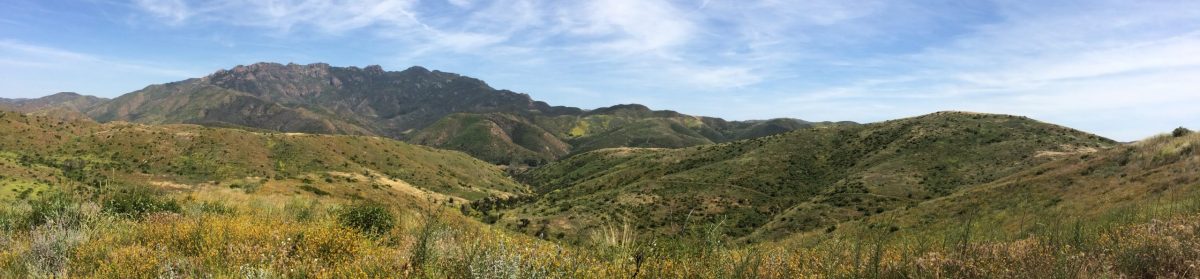
More to the point of our organization, the Santa Monica Mountains have suffered a severe blow. Many trails we enjoy are closed, including the Westridge Fire Road above my house, the Sullivan Canyon and Sullivan Ridge Trails, Rustic Canyon, and the Kenter-Canyonback Fire Road from Kenter up to dirt Mulholland. The fire is believed to have started at the Skull Rock formation on the popular Temescal Ridge trail, which of course is closed.

I haven’t said anything about the Eaton Fire, which also started in a beautiful ecological preserve above Pasadena and wiped out much of Altadena. Those are the San Gabriels, outside our jurisdiction.

Combined with the shocking political developments underway in our country, 2025 is off to an overwhelming, discombobulating and gloomy beginning. For environmentalists, the new administration’s neutering and dismantling of the Environmental Protection Agency (EPA), established by Richard Nixon in the 1970s, is alarming. And that’s just a small piece of the coming attack on the environment, and aggressive attempt to unwind everything accomplished over the last several decades.

The national Sierra Club is mounting a massive and expensive fight against all this, and we need to support that. For our Task Force, plenty of trail work and remediation lies in our future.

Eric Edmunds, Chair
Santa Monica Mountains Task Force

Palisades Fire trails update #3

SAVE THE DATE – Saturday 3/15, the Sierra Club crew will be joining with CA State Parks and Santa Monica Mountains Trails Council crew leaders to begin post-fire trail restoration work on the north side of Topanga State Park.

More information will follow next week. Subscribe to our mailing list for timely announcements.

Palisades Fire trails update #2

The trail damage assessments at Topanga SP and Will Rogers SHP following the Palisades Fire are nearly complete.

In a brief update last week, Jason Finlay, trails coordinator for State Parks, told us they had found “no major problems” such as slope failures or damage to structures on many of the impacted trails — including Leacock, Bienveneda, and the upper Temescal area. If the rain this week doesn’t exacerbate their condition, some trails, he postulated, could be reopened “relatively quickly” — as it should simply be a matter of clearing rockfall, removing slough, and re-exposing the trail tread, then building dips and drains to control water.

He also noted that once the assessments are finished, one of his team’s next priorities will be to start clearing some of the most popular State Park trails that are currently closed to the public, beginning with Los Liones Trail, and lower Will Rogers including Betty Rogers Trail and all the little trails within the historic zone.

There are a few spots, however, which Jason says “unfortunately aren’t going to reopen any time soon”. Temescal Canyon, in particular, was much worse than they had hoped to find it. He talked of major slope failures, and giant piles of landslide material. Active landslides were happening around them while they were logging damages in the canyon last Wednesday in the rain.

We recommend following the Angeles District of California State Parks on Instagram (@angelesstateparks), as well as the Mountains Recreation and Conservation Authority (@mrcaparks), for timely announcements regarding trail re-opening dates and extended closures.

Next week, park staff will meet with the volunteer crew leaders to go over their findings, and I expect to begin scheduling volunteer activities very soon after. Not only on the burned and bulldozered State Park trails, but also those administered by MRCA and other agencies, as well as the trails unaffected by the fire — which still need to be maintained! We will have a lot to do. Stay tuned!

• • •

In the meantime, here are some other key dates for your calendar:

Next meeting of the Santa Monica Mountains Task Force
Tuesday, March 4th, 7:00 pm

All are welcome! Call in to learn about the past, present, and possible future environmental threats faced by the Santa Monica Mountains, and discover ways to support our ongoing mission to preserve and protect them. Meetings are bi-monthly. Those who cannot join us in person will be able to participate via Zoom.

Santa Monica Mountains Trail Days
Fri-Sun, April 4th-6th

Trail Days is a beloved, free-to-attend, annual celebration of our local trails and parkland, held in Point Mugu State Park every April, and now in its 42nd year. Come out for just the day (Sat/Sun) to help maintain the trails — all within Pt Mugu, so no recent fire damage — or bring your camping gear and stay through the weekend. Volunteers can look forward to a complimentary BBQ dinner on Saturday night, a jumbo prize raffle generously sponsored by community members, and much more.

California State Parks Week / crew lunch party
Saturday, June 14th, 8:30 am

“Intro to Trail Maintenance” special event in celebration of California State Parks Week, followed by our crew’s traditional end-of-season lunch party.

Upcoming Outings with the Tuesday Moderate Hikers

2/25: Tapia Spur Trail to Malibu Creek State Park
3/4: Stunt Rd to Red Rock Canyon
3/11: Solstice Canyon/Deer Valley Loop
3/18: Stunt High Trail to Saddle Peak
3/25: Malibu Creek State Park to King Gillette Ranch

New hikes are regularly added to our Schedule of Activities. We typically have 10-20 people on each hike, everyone there to enjoy the outdoors and be with like-minded people.

Weekly outings with the Tuesday Moderate Hikers (TMH) are usually about 8 miles in length with close to 1,000 ft gain, and tend to end in the early afternoon.

Upcoming Outings with the Tuesday Conditioned Hikers

2/18: Piuma to Saddle Peak
2/25: Zuma Canyon Loop

The conditioned (TCH) hikes, also taking place every Tuesday, are typically longer and more strenuous, usually about 12 miles with about 2,000 ft gain.

-Rachel G.

Palisades Fire trails update

On Thursday night, I attended a meeting with several other stewards of the Santa Monica Mountains lands and trails including Jason Finlay, the trails coordinator for California State Parks Angeles District. Subsequently I want to provide our volunteers and supporters with an update, which includes a great deal of information from Jason.

I also want to take this opportunity to welcome the many new people who signed up to our trail crew mailing list in these last few weeks, as well as those who reached out by phone or email to ask how they can help. We’re very grateful to have you.

What has happened in the parks since the fires began?

Last week, as the fire agencies were still actively fighting the Palisades Fire, California State Parks brought in approximately 35 Resource Advisors (READS) from across the state. The READS work with incident command during the firefight to identify avoidance areas — for example, cultural sites, riparian zones, and areas with protected plants — and then, as containment grows, they shift to suppression repair.

State Parks has a developed fire suppression repair plan with CAL FIRE, which has already been used in the Santa Monica Mountains after earlier fires. Jason’s role during the incident has been to communicate the specific needs of the Santa Monica Mountains’ trails and roads between the various groups involved, and to get us set up as best as he can in the long-term for restoration of the State Parks trail network and surrounding habitat.

As the Palisades burned, the fire agencies were doing all they could to prevent the fire from progressing to Mandeville Canyon or the Valley — at one point, there were 60+ bulldozers on the incident, urgently pushing aside vegetation so the wall of advancing flames would meet only bare dirt.

The suppression repair agencies that come in behind the firefighters don’t do any trail re-building — or more accurately, there is no obligation of CAL FIRE to repair trail — mainly, they work with gigantic excavators and bulldozers to repair the many dozer lines that were cut during suppression, and put in water bars and other topographic structures to break up flow of rainwater. The heavy machinery operators had extra challenges to navigate where dozer lines intersected trails, ie. where our crews will eventually rebuild the trail with hand-tools.

Still, they were able to get a good amount of trail alignment “roughed back in”. Friday was the last day of suppression repair using heavy equipment; those teams have now demobilized and the equipment has left the park. Hand crews were still out working today, and as of this evening suppression repair has been completed.

The fire’s impact to trails

Jason confirmed that “pretty much all of Topanga ” and Will Rogers SHP trails burned, as well as some small sections of Malibu Creek SP, along the Backbone Trail on Fossil Ridge and above Monte Nido. Many MRCA and other agencies’ trails were also damaged.

Almost all of the trails in Friday’s L.A. Times article, These 28 hiking trails burned in the Palisades fire, were built by Ron Webster and his Sierra Club volunteer crew.

Topanga SP trails NOT in the burn area include Dead Horse, most of Musch, Hondo, half of Garapito, a stretch of the BBT adjacent to the elementary school, and Musch Meadows.

On Musch Trail, we learned there is a bad dozer line through sections of the trail just outside of Musch Camp on the approach from Eagle Rock, and through a couple of creek crossings. On Saddle Peak Trail, the dozers went through about 20 switchbacks, right down the middle. These will be particularly difficult, and take a great deal of work, to restore.

We lost the Chicken Ridge Bridge on the Backbone Trail above Will Rogers. This is an important link on the BBT, and will be the biggest single reconstruction effort for State Parks.

All the Rustic Canyon bridges burned through.

The bridge on Temescal Canyon Trail by the waterfall is also gone. In an uplifting email exchange I had with long-time Sierra Club crew member Noel Bell, he recalled the previous time the bridge here burned (and being part of the volunteer crew who installed the replacement).

Three former roads that had been trails prior to the fire were bulldozed, either for access or as fire breaks. Jason told us that Chaney Fire Rd, Henry Ridge Mtwy, and Farmers Ridge Fire Rd are now “three lane highways”. Since then, they have all had equipment working to restore their pre-fire footprints.

The access roads in Topanga SP were “highly impacted”. Jason said the crews did an excellent job of putting them back together, and the repair has left those roads in fairly good shape after a lot of work; however, with the newly denuded slopes, and potential added erosion from intersecting dozer lines, he expects critical failures at a lot of points, and even the loss of some roads if we get significant rainfall this winter. They will be racing to shore up what they can. His greatest concern for the roads is the saddle between Bent Arrow Trail and Garapito Trail.

We will have to reroute the entrance of Garapito Trail — something we were already looking into before the fire — as there has been significant change to the whole contour of that area.

During a pause in his cataloguing of the additional damages, Jason said:

“I’m really thankful for Ron Webster right now, and the “lightly on the land” ethos, because we don’t have a lot of [man-made] structures in these areas. That’s one of the big positives I’ve been taking away. These trails are laid out with minimal structure, and it’s really going to be a lot easier to repair because of that.”

To our surprise and relief, Ron and Mary Ann’s memorial bench on the Rivas connector between Topanga and Will Rogers survived the fire. MRCA ranger Fernando Gomez sent us a few pictures.

What comes next, and when will volunteers be able to help?

The next step for State Parks is to complete detailed assessments: logging the trails, getting a better idea of hazards, identifying the specific repairs that will be needed to start reopening trails, as well as estimating the costs — this is a FEMA event for the parks as well. They are starting with the most popular trails including Temescal Ridge and Los Liones. Jason noted that it’s still physically very difficult to hike into these areas to do the assessments, because there is 12-18″ of slough covering every trail, and he will send out staff crews to start clearing some of the debris ahead of the folks doing the assessments.

For the most part, the subsequent work is going to be a lot of clearing up rocks and slough. Most of the vegetation is completely burned out. There are not a lot of downed trees or things like that. More time will be needed to scope repairs to structures like bridges and retaining walls, which our volunteer crew will also assist with when the time comes.

One concern we have for the crews is working in all the ash, and the possibility of dangerous particulates. Hopefully we will get a little bit of rain (but not too much) to help everything settle down and then, with appropriate precautions, we can start tackling the work.

Sierra Club, Trails Council and CORBA trail crew leaders will be meeting with State Parks again next week, to go over their early findings and begin scheduling some volunteer work days. I’m told we might be able to start restoration work in early February.

I will share more information as it becomes available.

-Rachel G.

Thank you, CicLAvia volunteers!

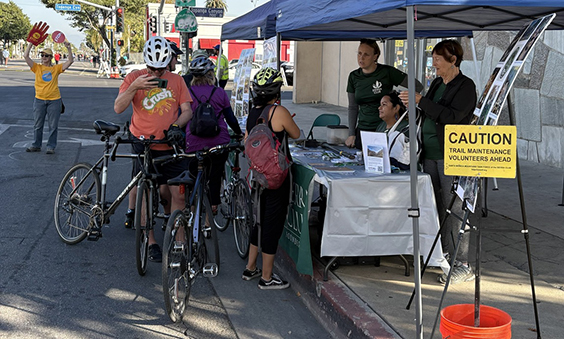
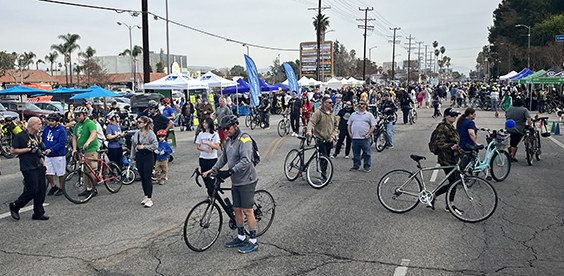
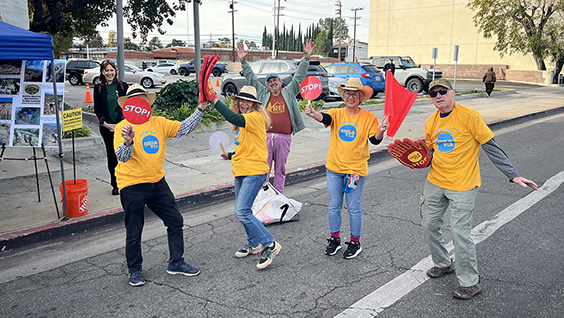
The volunteer trail crews of the Santa Monica Mountains Task Force (SMMTF) and the Santa Monica Mountains Trails Council (SMMTC) teamed up for a public outreach at the San Fernando Valley CicLAvia event in December of 2024.

Over 500 people visited our information table to learn about what we do for the benefit of all visitors to the Santa Monica Mountains National Recreation Area. Some visitors signed up for our newsletters, while others joined our crews to help with trail maintenance in the subsequent weeks and months.

CicLAvia events involve closing off 5-10 mile stretches of roadway for human-powered movement, helping to catalyze vibrant public spaces, encourage active transportation, and promote good health among the participants. The concept started 50 years ago in Bogota, Columbia. The first Los Angeles-based event was in 2010, and has grown to eight sites a year.

Participants range from runners to walkers, wheelchairs to skateboards, bicycles to unicycles, and so much more. You can feel the joyous energy as you move to the rhythms of others who celebrate being out and about simply for the sake of pleasure.

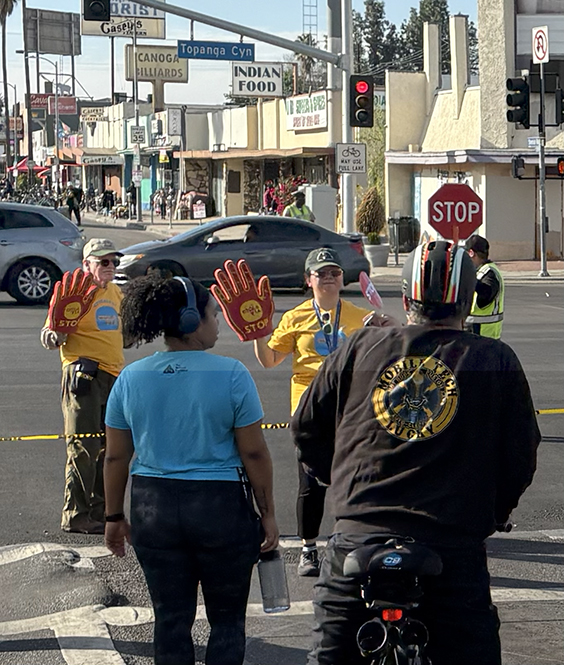
Our volunteers’ activities included ensuring participants paused when motorized traffic was allowed to cross the route, and to staff our outreach tables.

The organizers and affiliated organizations were thrilled with our efforts, and are excited to see us return in the future.

Support the Santa Monica Mountains on #GivingTuesday!

Whether you’re a hiker, biker, picnicker or sightseer, we all value the beautiful shared spaces of the Santa Monica Mountains. 

Through trail maintenance and vigilant activism, the Sierra Club’s Santa Monica Mountains Task Force is intimately involved in the preservation of these spaces, and on this Giving Tuesday, we’re seeking donations.

The money will help us with resources involved in trail maintenance, building awareness, and various other initiatives to preserve the mountains.

Every donation helps. Thank you!

Can you spare a few hours on December 8th?

We are in urgent need of more helpers for our outreach efforts at CicLAvia—The Valley on Sunday, December 8th, where we will be co-hosting an info booth with the Santa Monica Mountains Trails Council volunteer trail crew. No experience is required.

We have a great opportunity here to connect with the people who use the Santa Monica Mountains trails for recreation, and to let them know of the significance of the Sierra Club and Trails Council volunteer trail crews.

However, in order for our organizations to participate, we need enough volunteers confirmed by Tuesday, November 26th.

Two kinds of volunteering opportunities are available: assisting with traffic control, or staffing our booth to talk about volunteering on the trails.

Shifts:
8:30am – 11:30am (3 hrs)
11:00am – 2:00pm (3 hrs)
1:30pm – 3:30pm (2 hrs)

All volunteers will be provided lunch.

Assisting with Traffic Control

Using provided shirts and signs, volunteers will be supporting traffic control at vehicle crossing points by slowing / stopping participants, so that vehicles may cross at appropriate times. Don’t worry about the vehicles — traffic officers will handle all motorists, and any related issues. There will also be barriers and signs on the route to slow vehicle traffic.

In addition, volunteers will be providing directions to the participants, and answering route-related questions. A brief training orientation will be provided.

This particular job is very important, as our booth presence depends on us being able to provide volunteer traffic controllers.

Staffing the Booth

The second opportunity will be staffing our pop-up booth, offering information to folks who might be curious about the Sierra Club and Trails Council volunteer trail crews.

This is for everyone of all experience levels, from those who’ve been working trails for years to those who just recently joined us.

Please contact either of us to sign up for a shift, or if you have questions:

Rachel Glegg – Sierra Club
(310) 985-2826
rachel.dorman@gmail.com

Robert Bittner – Santa Monica Mountains Trails Council
(310) 941-9459
rsdinc86@gmail.com

Thank you!