Fall 2020 update from the Task Force Chair

As we know, all too well and bitterly, Fire Season is upon us. Although it’s barely begun, catastrophic wildfires have consumed not just California, but huge swaths of the coastal and inter-mountain West. Oregon and Washington just burned, losing many homes. Colorado is on fire, and they say won’t be out of danger until the first snows in October.

Two hundred hikers and campers in the Sierras barely escaped the Creek Fire with their lives, and then only because Chinook helicopters dangerously flew into thick smoke and airlifted them out. As I began writing this on 9/10, the morning’s Los Angeles Times showed the San Francisco skyline as an orange, smoky apocalypse. Although the Santa Monica Mountains have mostly not been stricken (yet), the Bobcat Fire in the San Gabriels, including Mount Wilson and Big Santa Anita Canyon — a hiker’s paradise — has scorched more than 115,000 acres and is still not fully contained. For a time, the thick smoke and poisonous air it dumped into the Los Angeles basin rendered any hiking, trail-running or outdoor exercise hazardous to your health.

For most of my 45 years living in L.A., fire season meant three months or so of the year centered around October. Now it’s 12 months a year. The Thomas Fire, which devastated the Santa Monicas and Los Padres National Forest, started in December of 2017 and took three months to put out, and then only because of the arrival of rains. I’d never heard of fire tornadoes before now, creating their own weather with flames 100 to 200 feet high, exhausting fire-fighters volunteering from all over the world, but welcome to the New Normal. The destruction caused by drought, and beetles, has killed thousands of square miles of California forests, making them tinder for the ravenous fires, especially around Yosemite and Lake Tahoe.

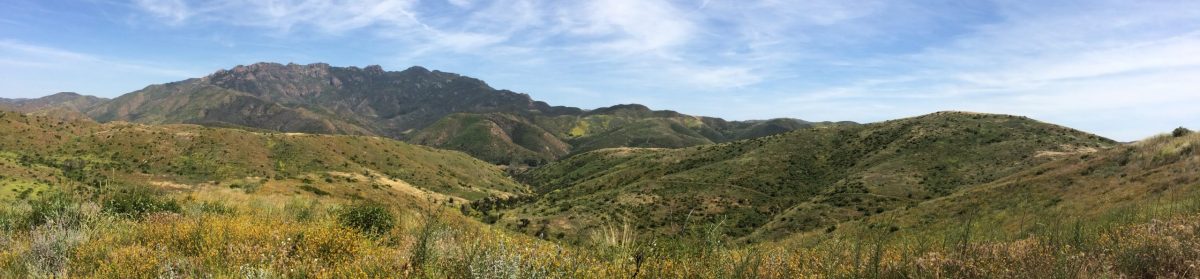
The Santa Monicas are America’s largest and only intra-urban mountain range. As we sit here today, the truly scary Santa Ana “devil winds” are still ahead. Remember the quaint old times when building a fire-break protected against the spread of a wildfire? Already all MRCA trails in the Santa Monicas, and the Santa Monica Mountains National Recreation Area, have been closed twice: the first, in April, because of COVID-19 overcrowding and people’s non-compliance with masks and social-distancing protocols; and the second, over Labor Day, because of the lethal heat wave that killed a 41-year-old female hiker in Tapia Park, near Calabasas. That day, Los Angeles County set an all-time record of 121 degrees. Many others had to be rescued and medevacked out. That’s also when the Bobcat Fire started in the San Gabriels.

So what, if anything, is the Sierra Club doing about all this? Your Chair has been busy. In August I spent a full day with a team of City of L.A. engineers, fire department officials and engineers including the Fire Chief, the head Ranger and the Deputy Director of the Santa Monica Mountains Conservancy, as well as community and homeowner-association leaders, to scout out locations for a new series of fire cameras throughout the Santa Monica Mountains. 

This exciting project — stretching across all of California, not just here — is being funded by public and private charitable money based out of U.C. San Diego. We surveyed a dozen or more locations, such as San Vicente Mountain Peak (Nike missile tracking station), Mountaingate, and the Green Mountain radar navigation station on the Temescal Ridge Fire Road, looking for the most panoramic, unobstructed and long-range views of the mountains. These cameras will be rolling 24/7, in real time, and accessible not just to the fire department but to everyone via the Internet. We know that early detection and extinguishment of these fires, which seem to start in the middle of the night or early morning, is critical. The fire department is enthusiastic, and says these cameras will allow them to detect fires and deploy resources earlier and with greater precision, when the fire can still be knocked down.

We’re also active on the legislative front. Recent legislation in Sacramento aggressively sought to “densify” housing across the state, effectively abolishing single-family zoning (among other companion legislation, SB 1120). Whatever you might think about this on the merits, as regards homelessness and the housing crisis, this legislation — which failed to pass in the closing minutes of the Assembly session — could be disastrous for the mountains. Most of these locations are known as Very High Fire Hazard Severity Zones. Attracting developers to buy land here, clear wilderness open-space and build dense and expensive (not affordable) housing, will be a grave and deadly mistake. Many of these new residences could be difficult or impossible to evacuate in a firestorm, as we tragically saw in Northern California.

That is why, on August 22nd, Sierra Club California passed a resolution opposing new building in Very High Fire Hazard Severity Zones, except for existing in-fill development, “to respond to increasing intensity and frequency of devastating wildfires on lives, habitat, property, infrastructure, and the environment.”

Stay tuned. This is all “breaking news.”

Eric Edmunds, Chair
Santa Monica Mountains Task Force

Summer 2020 update from the Task Force Chair

It has been two months since the trails reopened in the Santa Monica Mountains, in areas managed by State Parks and the Mountains Recreation & Conservation Authority. We can now begin to see how that is working out.

I’ve laced up my running shoes and hit the most popular trails, from Escondido Falls in Malibu to Elysian and Griffith Parks downtown. I’ve also run and walked on beaches and popular gathering-places like Palisades Park in Santa Monica.

There’s a LOT of people out on the trails. In part that may be because of folks going stir-crazy in their small apartments, perhaps surrounded by numerous family members. It’s also the onset of summer and warm weather, with the magnetic effect the beaches and outdoors have on Southern Californians at this time of year.

For those of us on foot in the mountains, what are we seeing? For one thing, not many face-masks and little social-distancing, although the more considerate folks cover their mouth and nose as they approach you. I’d say one-third to one-half of people on the trails carry a mask or bandana. With runners breathing hard (I myself carry a bandana), and especially with the younger cohort, unfortunately there is much less compliance. And with mountain bikers, almost no compliance. 

It’s certainly a buzz-kill for a hiker on a single-track trail, minding his/her own business, to be suddenly confronted with a shredder bombing straight at you at high speed, with barely time (if you’re lucky) to jump off the trail to save your life as the unmasked rider passes with zero separation distance.

The trails reopened on May 10th. Since then, times have changed at warp speed. Amazingly, face masks and social-distancing are suddenly political issues, red versus blue. Public health officials advocating for caution and conservatism are being harassed, intimidated (in L.A. County), and driven from office (Orange County). Pressure to “reopen” and revert to normalcy is irresistible. Bars and restaurants are tentatively open again.

Sadly, we are now starting to see the results. New cases, hospitalizations and new deaths are surging, especially in aggressive reopening places like Florida, Texas and Arizona. The virus never takes a holiday.

It is true that trails and the outdoors are safer than enclosed bars and restaurants. Fresh air, sunlight, and warm temps inhibit the spread, especially if you are hiking on a wide fire road where you can take evasive action, as opposed to single-track.

The months ahead will tell how all this works out. For me, despite the obstacles and disruptions, it’s a blessing and a privilege to get outdoors and hit the trails.

One final observation: If you see a black stick on the trail, don’t step on it. There’re a lot of rattlesnakes this season.

Eric Edmunds, Chair
Santa Monica Mountains Task Force 

Spring 2020 update from the Task Force Chair

In the past year, the Santa Monica Mountains Task Force of the Sierra Club has been instrumental in saving or fighting for wilderness open space and public access to trails in the Santa Monica Mountains. The threats variously come from proposed development by speculators, and millionaire or billionaire celebrities.

June 2019 article by Los Angeles Times pundit Steve Lopez described our Task Force as a “David” in the fight against “Goliath.” Sometimes David wins.

That happened last year, when California’s Court of Appeal reversed a trial court ruling (and an earlier ruling by the California Coastal Commission) that allowed the band U2’s guitarist The Edge (David Evans) to grade a massive project in pristine open space in Sweetwater Mesa above Malibu (overlooking the pier) for construction of five mansions for himself and friends. By the end of this ten-year fight, the Task Force was the only player left in the ring, willing to litigate to protect the mountains.

In a surprise upset victory, the Court of Appeal reversed and sent the project back to the drawing board, where The Edge faces a difficult (and, we hope, futile) uphill battle to gain approvals from the County Board of Supervisors.

For now, that exquisite property will remain unscathed, and home to cougars, birds and wildlife — and, hopefully, a tax-incentivized donation to a public agency like the Santa Monica Mountains Conservancy (SMMC).

Elsewhere in the mountains, we are battling Swiss billionaire Nicolas Berggruen, who has launched a proposal to build The Berggruen Center, a massive Getty Center-like “think tank” in the Sepulveda Pass above the 405. This would invade wilderness open space south of Mountaingate, and, more important to us, threaten the Riordan Trail (a hiking trail connecting Mount Saint Mary’s College) down into Bundy Canyon (a beautiful riparian wooded canyon) and climbing up to the Kenter-Canyonback Fire Road in Brentwood. Over ten years ago, we fought the powerful real estate conglomerate Castle & Cooke to secure this easement and trail, later built by and dedicated to the Mountains Recreation & Conservation Authority (MRCA).

The neighboring Mountaingate Homeowners Association has already filed the first lawsuit to challenge this. The MRCA has signaled its willingness to litigate to protect its public open space conservation easement over nearly 90 percent of Berggruen’s property. The Task Force is watching these developments closely, and is ready to again swing into action if necessary.

The City of Malibu is a sprawling community extending for 28 miles from Santa Monica to Oxnard, where the Santa Monica Mountains meet the sea over hundreds of square miles of rugged open space. Unfortunately, the City, its elected representatives, and local property owners have fought for years to keep the common public out of its trails, campsites, and hiking staging areas. 

A hotly-contested fight is currently underway in the enclave of Sycamore Park, a popular trailhead leading to Escondido Falls — the only year-round waterfall in the Santa Monica Mountains. Certain homeowners have closed off Via Escondido Drive and hired a security guard company to turn away members of the public seeking access to the trailhead. The Malibu Times and its owner Arnold York have begun publishing articles in support of the ban, attacking the MRCA and Santa Monica Mountains Conservancy (a state agency). The agencies are battling both the homeowners and the City of Malibu from illegally blocking the public. The Task Force is supporting this fight, now pending in Santa Monica Superior Court, and we’re following developments closely.

On a more encouraging and promising note regarding Malibu, the City just passed one of the strongest bans in the state against the use of highly toxic rodenticides aimed at rats and vermin. As these poisons work their way up the food-chain, through coyotes, bobcats and other carnivores, they reach apex predators like mountain lions — already endangered — who, as a result, are now dying of internal hemorrhaging.

The Task Force wrote to the Malibu City Council, which passed the first-ever ban on these poisons. It’s being challenged in court and in the legislature.

The threats to trails, wilderness open space, and its four-legged denizens are never-ending. In this business there are no “final” victories: new proposals for development or exclusion of the public are continuous. 

The Santa Monica Mountains need all the help they can get, and that is our mission, also unending. Come to one of our meetings to learn more.

Eric Edmunds, Chair
Santa Monica Mountains Task Force