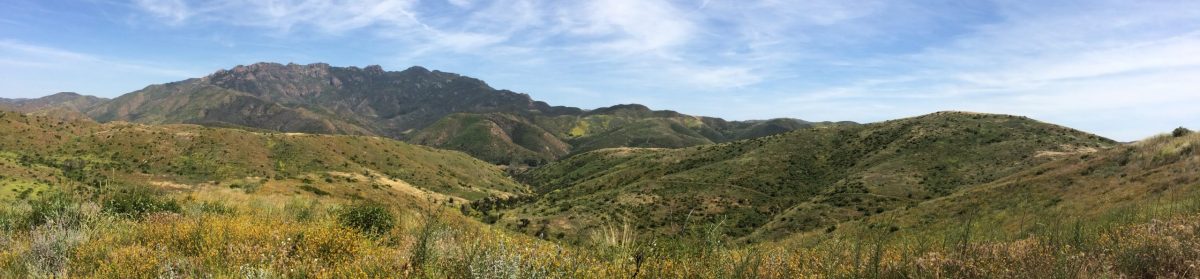
In honor of the late Alex Trebek, we thought we’d acknowledge the Trebek Open Space, 62 acres of parkland in the Hollywood Hills that, in 1988, was donated to the Santa Mountains Conservancy by the iconic Jeopardy! host.
Nestled specifically in Nichols Canyon in the eastern Santa Monica Mountains — and right next to Runyon Canyon — the space offers a network of trails for bikers, hikers and horseback riders.
On December 2nd, after many delays, the amendment to add the toyon and Mexican elderberry to the City of Los Angeles’s Protected Tree Ordinance was heard before the City Council’s Public Works and Gang Reduction (PWGR) Committee. The amendment was unanimously passed, with the Committee choosing to support a superior measurement standard that had long been sought by tree advocates.
These two native species, which grow as shrubs or small trees, were used for many and varied purposes by indigenous peoples — the toyon’s pomes used as food or made into a jelly, and the leaves, flowers, and bark used to make different medicinal teas. The two species are also highly important for wildlife as a source of food, and as an integral part of the ecology of our hillsides. As the Center for Biological Diversity wrote in their letter to the Committee:
“Toyon berries provide a source of food for native birds including American robins, western bluebirds, mockingbirds, and California quail. Toyon also is a prominent component of the coastal sage scrub plant community and is evolved to thrive in Southern California’s drought-prone landscapes. Likewise, Mexican elderberry is a key source of food for Southern California’s birds, and acts as a host for many species of butterflies and moths. Both shrubs provide much-needed shade for mammals, birds, and reptiles during hot summer days, and can provide nesting sites for some species.”
The Santa Monica Mountains Task Force was among the many environmental and stakeholder organizations to submit a letter of support for the addition of these species to the Protected Tree Ordinance. The process to add the two species was begun seven years ago by some members of the City’s Community Forest Advisory Committee (CFAC). Much of the delay in its progress was due to repeated efforts by the Urban Forestry Division to reduce the number of trees that would qualify for protection by insisting a different measurement standard be applied to the two new species.
The recently appointed City Forest Officer, Rachel Malarich, in an October staff report, joined UFD and the City Planning Department in supporting the changed measurement standard that would have seen few of these ecologically vital small trees protected. The SMMTF joined other organizations in supporting the call of CFAC to apply the same measurement to the new species that applies to the four species already protected in the Ordinance — that the diameter of the trunks or stems be a minimum of four inches, measured cumulatively, at four and a half feet high.
The SMMTF letter was referenced in the hearing by the Committee Chair, Councilmember Bob Blumenfield, long a champion of our protected native trees. He read aloud the following paragraph as being aligned with his thinking as the City moves forward with a separate comprehensive overhaul of the Protected Tree Ordinance:
“Developers should be advised at the outset of their projects that the City expects — and potentially in the future even rewards — project design that accommodates the retention of the naturally occurring native habitat on their sites so that removals of protected native trees and shrubs are largely avoided up front. They should also be informed early that any absolutely necessary removals will need to be mitigated through the planting of the same species on site at the current Board-mandated 4:1 ratio. This “education” of developers at the front end could serve to make removals and replacements less common generally, and help reduce and avoid an expressed “need” for off-site and out-of-kind replacement plantings.”
The Task Force also supported the Community Forest Advisory Committee’s additional (and, unfortunately, unsuccessful) recommendations in their letter of November 16th to the PWGR Committee, which called for the administration of the Protected Tree Ordinance to be removed from the Urban Forestry Division and housed in an environmentally oriented department such as LASan’s Biodiversity unit, and for the team administering it to include a biologist or ecologist and an architect, rather than only the UFD staff arborists recommended by the Bureau of Street Services, in order to provide an appropriate knowledge base for this work.
After passing through the PWGR Committee, the amendment subsequently went before the full City Council for its final vote on Tuesday, December 15th, where it was again unanimously passed.
On November 4th, the California Coastal Commission ordered the LA Department of Water and Power (LADWP) to pay $1.9 million for restoration efforts after the utility bulldozed environmentally sensitive chaparral shrubland by Pacific Palisades, destroying nearly 200 Braunton’s milkvetch plants, which are federally protected under the Endangered Species Act.
The destruction began in March of last year, when LADWP began replacing a large number of wooden poles with fire resistant steel ones just north of Will Rogers State Beach, in the Santa Monica Mountains. To facilitate the completion of the project, the utility expanded and graded the Temescal Ridge Fire Road, and added 30 branching roads.
“Our task force has been involved with far too many cases of utility companies not using good judgment and failing to comply with the laws, policies, and ordinances that are in place to protect and preserve our finite natural resources,” wrote Eric Edmunds, Chair of the Santa Monica Mountains Task Force, in a letter addressed to the Coastal Commission.
The Braunton’s milkvetch, Astragalus brauntonii, is a purple-petalled perennial wildflower endemic to the Mountains. Only an estimated 3,000 remain today, after a century-long battle against continuous urbanization of the area. In 1998, for example, a milkvetch patch was deliberately destroyed by a Ventura County developer, despite ongoing negotiations with agencies to protect it.
The LADWP’s activities impacted 28 acres of Department of Parks and Recreation land, housing coastal chaparral, coastal sage scrub and 2.72 acres of federally listed critical habitat for Braunton’s milkvetch. What’s more, the grading was poorly done, spilling over and crushing vegetation downhill; some runoff even made its way into the watershed.
“What is quite alarming is that LADWP would even consider bringing this type of destruction into a State Park,” Edmunds wrote. “Our parks and protected open spaces are scarce and sacred – they deserve our highest level of respect and protection.”
The tragic uprooting was avoidable. LADWP failed to consult the Coastal Commission’s staff, as well as the accessible statewide database of endangered species habitats. Local hiker and botanist David Pluenneke had alerted the LADWP about the Braunton’s milkvetch’s endangered status, and was thanked for doing so. However, eight days later he returned to find several acres of destroyed vegetation.
“It’s hard not to think that if there had been blue whales and panda bears up there, they would have bulldozed them, too,” Pluenneke told the LA Times.
The Coastal Commission’s cease and desist order was reached in cooperation with LADWP, and with input from other agencies and local organizations, including the Sierra Club Los Angeles Chapter. It requires that the LADWP halt further development until seeking a permit from the Commission, undo the roadwork, place temporary erosion control measures and revegetate the area with native species. Further, LADWP will continue to monitor the damage it caused.
Of the $1,947,500 the utility will pay to remedy the violation, 575,000 will go to settling liabilities with the State Coastal Conservancy, $272,500 will go to the Department of Parks and Recreation for habitat enhancement, and the remainder will go to the Mountains Recreation and Conservation Authority to purchase and protect new property.
“The fact that $1,100,000 will go towards the acquisition of property that will be conserved (and protected!) for the next generations is very exciting,” Edmunds said. “And gives us hope for the future.”
One of the things I’ve learned in 30 years as an environmentalist fighting legal and political battles to save and preserve wilderness open space in the Santa Monica Mountains is, there are no permanent victories.
Just when you think you have achieved something final and forever, ten or twenty years later, the beast re-awakens and roars back to life. A wealthy developer or builder, eyeing a jewel of a parcel of pristine open space, armed with seasoned high-priced lawyers from the city’s premier land-use firms, makes a move.
This can be depressing and discouraging, but requires us as environmental activists to remain vigilant, intrepid, determined, and ready to keep fighting.
That is where we find ourselves today with the so-called Berggruen Institute in the Sepulveda Pass in the Santa Monica Mountains.
Last week (as I write this) was the official City of Los Angeles “Scoping Meeting,” the first step in entitling this massive project under the City’s codes and process, and the California Environmental Quality Act (CEQA).
Swiss billionaire Nicolas Berggruen is currently planning to build a vanity project “think tank” supposedly dedicated to “advancing good governance and environmental stewardship” on the 447 acres of open space in the former Mission Canyon landfill area of the mountains. The area in question spans from upper Mandeville Canyon to Mountaingate and consists of two ridges: Ridge 2 above Mandeville Canyon, and another north of Mountaingate and south to Mount Saint Mary’s College (Ridge 1, Stoney Hill Ridge). More than 420 acres of this land is protected open space, including the heavily trafficked Canyonback Trail and Mount Saint Mary’s Fire Road, outdoor treasures which the surrounding communities have fought long and hard to protect.
According to agreements between Mountains Recreation and Conservation Authority (MRCA) — a government agency, and the former owners of Berggruen’s property — much of the area currently being discussed for development cannot be developed. In 2017 their plans showed serious encroachments into protected land. These protected areas do not belong to a developer, but rather belong to the people of California, held in trust for future generations. This precious wilderness houses native plants, coyotes, great horned owl, quail, deer, mountain lions, etc. Overdevelopment of these lands presents significant other immediate risks to the community — from fire hazards and higher traffic to increased noise and light pollution.
Berggruen’s goal is to rival, in regal splendor, the Getty Museum to the south (J. Paul Getty) and the Skirball Center to the north. Except those institutions are open to the public, but Berggruen’s private “think tank” will not be. It will impact important trails used by hikers and the public, including the Mount Saint Mary’s Fire Road from the college up to Mountaingate, and also the epic Riordan Trail linking that fire road down into Bundy Canyon (a beautiful riparian Oak and Sycamore-studded canyon) and up the other side to Canyonback Road. Creation of the Riordan Trail was an important Sierra Club victory ten years ago, for which I as your Chair was honored ten years ago.
Importantly, Berggruen has no right to build this project. It may violate numerous easements, including a Conservation Easement held by the MRCA, and City codes and regulations. Berggruen’s answer to that is for his lawyers to propose to change the rules, enact an unprecedented amendment to the City’s General Plan, and ask for zoning variances and other deviations from the Building Code, and the Baseline Hillside Ordinance. The MRCA hired counsel to vigorously defend the public easement, and the neighboring Mountaingate community has won the first important skirmish in their lawsuit against him.
But when you’re a billionaire, nothing is too much to ask for: you never hear the word “no.” The world is your oyster.
Speaking of the world, Berggruen has built vanity projects allegedly dedicated to “good governance” all over the world. According to reporting, his normal modus operandi is allegedly to make “gifts” and contributions to whatever local officials need to approve his projects.
As anyone knows who has been reading the newspapers lately, local officials in Los Angeles who have taken large contributions from developers are disgraced or pleading guilty to bribery and corruption, including former Councilmembers Jose Huizar and Mitch Englander, and a former deputy mayor and the head of Building and Safety. But Berggruen has feathered his nest with many elected officials who support his goals of “good government,” democracy and reexamining capitalism. And who, incidentally, would like a splashy prestige project to go up in their district.
We fought this battle 15 years ago. The prior owner of the property, developer Castle & Cooke (who built Mountaingate) sought permits from the City to build 29 luxury homes on the subject property. But that would have entailed cutting off the Mount Saint Mary’s Fire Road and other hikers’ access to this portion of the mountains. We sued to protect those rights, and after intense litigation, achieved a City-brokered settlement that protected 95 percent of the land as a public Conservation Easement, protected or preserved historic Canyonback Trail, and created a new hiking trail down into Bundy Canyon, and a new trail, and up the other side. Victory achieved! Or so we thought.
As I said at the beginning of this piece, no victories are permanent in the Santa Monica Mountains. Constant vigilance, intrepidness and stomach for battle are required. That’s where we are now, folks.
Fortunately, the Sierra Club is part of a great coalition of activists, environmental land-use lawyers, organizations and HOAs opposed to this project and dedicated to fight. Stay tuned for updates about the City’s land-use and CEQA process. We’ll keep you informed.
Eric Edmunds, Chair Santa Monica Mountains Task Force
Just south of the Santa Monica Mountain range lie Baldwin Hills Scenic Overlook and the Kenneth Hahn State Recreation Area, city gems long hidden in plain sight. Beginning in 1998, our trail crew built the first of what became eight miles of hiking trails snaking across this urban park, casually considered a kind of a hiker’s “warm up” to the Santa Monicas. One of Kenneth Hahn’s especially popular trails, “Ron’s Trail,” was dedicated by County Supervisors to honor the trail crew founder, Ron Webster. Today, the crew continues its trail maintenance at the park, and participates there every January in the Martin Luther King Day of Service.
Several of our trails connect with the Park to Playa Trail, a 13-mile route newly-completed now with the bridge over La Cienega Boulevard that links Kenneth Hahn to the Stoneview Nature Center, Baldwin Hills Scenic Overlook and the Ballona Creek bike path. One can now strap on their hiking shoes at the corner of South La Brea Avenue and Don Lorenzo Drive and walk in peace all the way to the ocean.
Thus, we’re happy to report that the Baldwin Hills Conservancy recently granted North East Trees — a program dedicated to “greening up” urbanized areas — over a million dollars to implement what’s known as the Five Points Habitat Restoration Project. In a letter of support to the Baldwin Hills Conservancy, our vice-chair Bill Vanderberg cites, the project will “aim to restore native habitat along the Park to Playa Trail, bolster the ecosystem of the Ballona Creek watershed, improve water quality and storage, provide conservation benefits for people and wildlife, increase climate resiliency, and provide jobs skills training for local at-promise youth through the restoration of native ecosystems.”
Well, this one is simple for me. As the owner of two fairly small dogs, I’m dog-matic (yeah, yeah) about leashing them no matter where we’re walking. A recent case, Wolf v. Weber, put this debate into starker relief for local park culture, where the plaintiff (Wolf) suffered minor injuries as a result of being unexpectedly “bumped” by an off-leash dog while hiking on a trail in the San Francisco Bay Area.
Though Weber tried to argue that hiking in off-leash areas entails certain risks, the court ruled in favor of Wolf. You can read the official court opinion in full here. Consequently, dog-owners from now on can be held liable for incidents involving unleashed or “uncontrolled” dogs.
Leashing your dog might not only save you from a lawsuit; it will keep your beloved canine safer, especially on trails known for rattlesnakes, coyotes and the occasional mountain lion.
Sierra Club hikers in their 60’s and 70’s can often be heard to say, “We want to be like Ernie when we grow up.” It’s easy to see why.
Ernest M. Scheuer made the Los Angeles Westside his home around 25 years ago, after retiring in 1993 from NASA’s Jet Propulsion Laboratory in Pasadena. Before JPL, he taught at Cal State Northridge for more than two decades.
In his search for new places to hike — and new people to hike with — on the Westside, Ernie turned to the latest issue of the Sierra Club Angeles Chapter’s Schedule of Activities, where he learned of the Tuesday Conditioned Hikers (TCH) and subsequently its sister group, the Tuesday Moderate Hikers (TMH). These two groups, both sponsored by the Santa Monica Mountains Task Force, have been leading the public on hikes in the Santa Monica Mountains since the early 1970’s.
And so began his many years of exploring the peaks and trails of the Santa Monica Mountains.
Ernie leading a hike for the Sierra Club | Photo by Bob Cody
Ernie became a Sierra Club outings leader in 2007, and has subsequently been a mentor and provisional evaluator for several others. He is well-known to be a “quietly rock solid leader” who many find to be a calming presence on the trail. He has been described as “selfless” and “stalwart”.
In Ernie you will also find a great conversationalist: thoughtful, knowledgeable on a number of topics, and forever curious — he always takes a great deal of interest in anything his hiking companions share with him. He is also, according to his friend and TCH hiker Jeri Segal, “a bit nerdy (in the very best sense!)”
Ernie has done a great deal to support TMH and TCH off the trails, too, including serving as Outings Chair for TCH, taking the lead in scheduling the weekly hikes and writing them up for the schedule, maintaining the sign-in sheets, and additionally undertaking the role of Safety Chair for both groups. In 2015 he received the Outings Service Award from the Angeles Chapter for his dedication to the program.
To mark his milestone birthday in July, Jeri Segal conspired with his friends in the Club and beyond to surprise him with a “birthday book”, bringing together an astonishing number of heartfelt tributes, special memories, cherished photographs, and entertaining anecdotes.
Fellow hiker Craig Percy said of his friend, “One thing that makes Ernie special for me is his eyes and smile. He always, always, has an impish grin and sparkle. He always looks like he’s ‘up to something.'”
On the morning of September 23rd, 2020, California Highway Patrol discovered a mountain lion sprawled out on the 101 highway in Calabasas. Young and uncollared, the animal had been fatally struck by a car while attempting passage to the other side.
This is just the latest example of the dangers faced by our native big cats in the Santa Monica Mountains — the largest urban national park in the nation — where the arteries of growing human habitation have divided and strangled the natural habitat of the mountain lion.
A 2016 study published by the National Park Service and UCLA biologists found that, if current trends of genetic stagnation continue, the Santa Monica mountain lion population has a real chance of going extinct within 50 years. It came as a troubling surprise when, earlier this year, NPS researchers uncovered the first signs of this lack of genetic diversity.
Images courtesy of National Park Service
P-81: a tell-tail sign
In March, Jeff Sikich, the NPS fieldwork lead tracking our mountain lions, came across subject P-81. The cat had some unfortunate quirks believed to be a manifestation of inbreeding: the tip of his tail kinked at a 90 degree angle, and having only one descended teste (a condition called cryptorchidism). Based on footage from wildlife cameras, it seems there may be at least another mountain lion with a crooked tail in the Santa Monica Mountains, though this cosmetic deformity seems inconsequential to them. The undescended teste, on the other hand, is worrisome as it has been linked to reproductive difficulties.
“This is something we hoped to never see,” Sikich said in a statement. “We knew that genetic diversity was low here, but this is the first time we have actually seen physical evidence of it.”
Los Angeles already has one of the least genetically-diverse mountain lion populations in California and across the West. A cautionary tale lies in what happened to the Florida panther population, where similar birth deformities foreshadowed a breeding depression that almost entirely wiped out the animal from the state.
The Florida panthers were revived when fresh blood was introduced into their decimated population, in the form of eight female panthers translocated from Texas. While our own fragmented mountain lion community is similarly in need of new genetic material, biologists have stressed that relocating cats from outside of the Santa Monica Mountains would provide only a temporary solution — without addressing the issues that brought about the current level of inbreeding, they would be importing new mountain lions indefinitely, and at great cost.
Progress on the Liberty Canyon Wildlife Crossing
A more permanent solution comes in the form of the Liberty Canyon Wildlife Crossing, a first-of-its-kind bridge project to reconnect the divided habitat.
During a virtual presentation on September 23rd, Beth Pratt, Regional Executive Director of the National Wildlife Federation revealed some never-before-seen mockups of the project, which has been taken up by landscape architecture firm Living Habitats.
That the project is advancing, if slowly, is a big deal for the activists who have been fighting for it for decades. Once completed, the crossing could provide the model for addressing fragmentation issues all over the West.
Images courtesy of National Park Service
A summer of kittens
Between May and August, thirteen kittens were found across 5 different den sites in the Santa Monicas. Three of these litters are suspected to have been fathered by P-63, an out-of-towner from the Simi Hills. He represents an important injection of new genetic material into the population.
Unfortunately, one of the litters was orphaned at a young age when their mother, P-67, succumbed to the effects of rodent poison. This prompted researchers to attempt a “fostering” of the two orphaned kittens, P-91 and P-92, by another female mountain lion who had also recently given birth.
The fostering didn’t stick, but the kittens now serve as ambassadors for the Santa Monica population at the Southwest Wildlife Conservation Center in Arizona, and researchers continue their attempts to better understand and nurture these apex predators in our collective backyard.
Turning the tide on rodenticide
The mountain lions and their human advocates gained a major victory in September when Gov. Gavin Newsom signed into law the assembly bill AB 1788.
Put forward by Westside Assemblymember Richard Bloom, it restricts the use of certain anticoagulant rodenticides. These increasingly potent poisons which operate by thinning the blood of their targets, resulting in uncontrollable and fatal bleeding, have been found in 85% of our tested mountain lions, and directly implicated in several of their deaths. They have also been wreaking havoc on state wildlife at large, particularly where larger predators are concerned.
The bill drew widespread support, garnering 10,000 signatories after it was reported that a bobcat and a mountain lion from a nearby population in the Santa Susanas had died from rodenticide poisoning in August.
In a statement, the governor wrote: “My father was a naturalist and a strong advocate for the preservation of mountain lions, and I grew up loving these cats and caring about their well-being. He would be proud to know that California is taking action to protect mountain lion populations and other wildlife from the toxic effects of rodenticides.”
And, of course, you — the public — can also take action to protect our neighbors in nature. Start by checking out P-22’s Wildlife Wonderland on October 23rd, an online festival celebrating Griffith Park’s most eligible bachelor.
Los Angeles is lucky to be home to one of the most incredible species on the planet (we share with Mumbai the distinction of being one of two major cities to harbor big cats), and we can only be enriched in our efforts to learn about and protect them.
Over a decade in the making, the somewhat garish, land-gobbling “Savannah Oaks” project off Mulholland in Woodland Hills has been stalled, or perhaps stopped altogether. The development of 19 three- and four-bedroom homes was submitted in 2005 and has been met with several fierce obstacles and appeals from the surrounding community as well as the MRCA and the SMMC. Among the environmental casualties — besides the potential fire risks — would be fifteen protected coast live oaks.
We’re sad to announce the recent passing of Jerome Daniel, originally a Chicago native who moved to Los Angeles and, like so many of us, fell under the enchantment of our local Santa Monica Mountains and its many treasures large and small.
Daniel was a key figure in planning the Mulholland Scenic Parkway (where an overlook above the Hollywood Bowl is named in his honor), and went on to chair the Santa Monica Mountains Conservancy, where he oversaw the preservation of some 50,000 acres of parkland.