Water, water everywhere (kind of)

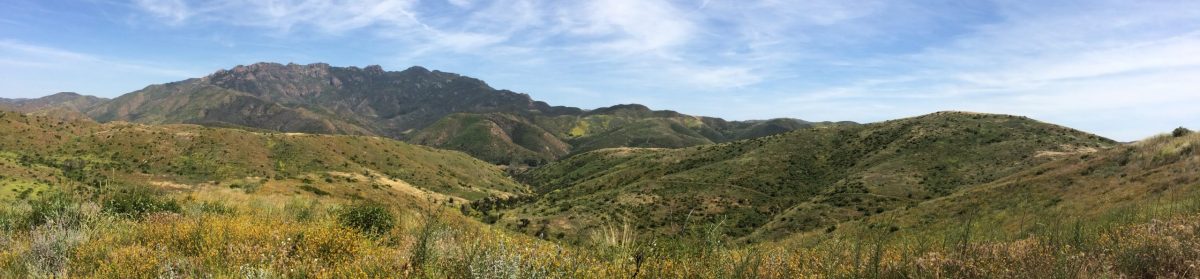
Like many other lovers of these local mountains, I was eager to see what the week of heavy rains had wrought along several (ostensibly water-adjacent) trails. And, like many, I wasn’t disappointed: gushing waterfalls, and creeks and streams with strong enough flow you might’ve expected a sun-speckled fish to pop out here and there. 

KTLA reported on this (temporary) wetting of our wildlands:
https://ktla.com/news/local-news/rain-brings-seasonal-waterfalls-back-to-santa-monica-mountains/ 

It’s important to keep in mind, though, that the rains weren’t heavy enough to relieve us of the drought. According to the State of California’s Drought Action website, it would take 140% of the state’s normal annual rainfall to put us in a surplus, so to speak.

Storm damage on the Bent Arrow Trail | Photo by Rachel Glegg

At the same time, it’s hard to overstate the immediate damage that severe storms can have on trails, and parks in general. Personally, I witnessed the flood damage in Malibu Creek State Park: piles of debris so high and dense that it was difficult to even navigate a way to the M*A*S*H filming site. The Bent Arrow trail (above) is officially closed for the time being, and reports of landslides and downed trees in Hondo Canyon and the Garapito Trail, respectively, are but two of many similar incidents we are working in partnership with the land agencies to address.

See smmtf.org/trail-crew for information about volunteering to help repair the trails.

Liberty Canyon Wildlife Crossing gets $10M boost

Governor Newsom’s 2022-2023 budget bears some heartening news for local wildlife and its supporters: namely, $10 million allocated for the Liberty Canyon wildlife crossing in Agoura Hills, a vision now quickly marching toward a much-needed reality.

Newly christened in September 2021 as the 101 Freeway Wallis Annenberg Wildlife Crossing, the bridge is projected to run 210 feet long and span the entire ten-lane freeway, and construction is set to begin this month.

Board of Forestry and Fire Protection set to weaken wildfire safety regulations

Sierra Club’s fight for common-sense wildfire safety continues. The California Board of Forestry and Fire Protection is considering drastically weakening State minimum fire safe regulations that have been in place for 30 years. If adopted, these regulations would make it more difficult for communities to evacuate during wildfires and more dangerous for firefighters to access existing, substandard roads.

Sierra Club has been a steadfast advocate for fire-safe communities at the Capitol, and in state agencies. We have called for more funding for defensible space and home hardening. We have supported legislation that would require wildfire safety planning to be incorporated into cities’ general plans. The Sierra Club also adopted a policy of opposing new development in very high fire hazard severity zones.

This month, Sierra Club California joined environmental and community organizations representing millions of members and supporters across California to urge the Board of Forestry not to adopt these harmful regulations. In addition to making it more dangerous to evacuate during emergencies, these harmful regulations could also make it easier to build new residential and commercial development in fire-prone wildland areas — putting more people and firefighters in harm’s way, and increasing economic risk from future fire. 

To make matters worse, the board is unlikely to examine any major environmental impacts from these regulations, in violation of the California Environmental Quality Act (CEQA). Without a CEQA analysis, it is much more difficult for the state of California to plan for and avoid environmental consequences. 

California wildfires have destroyed countless homes and taken far too many lives, and the climate crisis will only make wildfires more severe in coming years. The state must take steps that make fire-prone communities safer. The proposed regulations would do the opposite.

Join us to fight against these dangerous regulations. Send a message to the Board of Forestry at PublicComments@BOF.ca.gov and tell members to reject the proposed 2021 State minimum fire safe regulations and to complete a CEQA analysis. Click here for a sample email.

Thank you for taking action!

Featured image by Glenn Beltz licensed under Creative Commons BY 2.0

Don’t mess with the coast!

The Coastal Commission has been given a new legislative weapon to fight those who would damage coastal environments.

Senate Bill 433 would ensure the Commission’s authority to levy fines for practices destructive to native flora and fauna, such as that of the Great Blue Heron, discussed in this L.A. Times article.

Previously, they could only fine private property owners who restricted access to public coastal areas. Now, those who bulldoze, or tree-trim, better think twice.

Retiring the Rindge Dam

The Twenty-First Century Dams Act is a recently-introduced bill that would invest $21.1 billion to enhance the safety, grid resilience benefits, and power generating capacity of America’s dams, and provide historic funding to remove dams that are no longer necessary.

The Santa Monica Mountains Task Force, along with California Trout and the Surfrider Foundation Los Angeles Chapter, is in favor of passing this bill, and we plan to work to get it passed in congress to secure funds to help remove the Rindge Dam in Malibu Creek State Park.

The Rindge Dam was built in 1926 by the Rindge family, to have access to the Malibu Creek water to irrigate the crops on their ranch. However, the dam was decommissioned in 1960.

Southern California steelhead trout (Oncorhynchus mykiss) were abundant in the Malibu Creek before the dam was built; consequently, the Rindge Dam prevented the anadromous fish from migrating to the ocean. As a result, the Southern steelhead is now on the endangered species list.

The removal of the Rindge Dam would restore the Malibu Creek ecosystem and possibly bring back the Southern steelhead in the Malibu Creek. However, the construction cost of the dam removal is more than $100 million. Funding has been a big issue holding the project up.

In addition, the removal of the dam will bring back sand to the Malibu Lagoon beach. The dam prevents rock sediment from flowing down to the beaches, resulting in beach erosion, according to Michael Monak, Chair of the Coastal Preservation initiative at the Surfrider Foundation Los Angeles Chapter.

Please write your representative and senator to urge them to vote YES on the Twenty-First Century Dams Act and bring back the ecosystem to Malibu Creek, restoring not just the habitat for the Southern California steelhead trout but also for the western pond turtle, two-striped garter snake, and the Pacific lamprey.

Visit house.gov to find your representative.

Back to (trail) work

The SMMTF trail crew is back!

National Public Lands Day on September 25th marked our official return, with a special project at Peter Strauss Ranch, which was severely damaged in the 2018 Woolsey Fire and is temporarily closed to the public.

Following a brief project orientation and work safety presentation, we distributed and demonstrated tools before heading out onto the trail in small groups. Volunteers helped to restore the trail tread (surface) with digging tools, and cut back heavily overgrown vegetation and fallen tree limbs with saws, loppers and shears to open up the trail corridor.

Our work to repair this scenic half-mile hiking trail is part of a larger effort by the National Park Service to address the impacts of the fire and restore this historic site to a safe condition, with tentative plans for the park to be reopened to visitors in the coming months.

The volunteers of our 2021 National Public Lands Day event

Among our NPLD volunteers was the Sierra Club Angeles Chapter Director, Morgan Goodwin, who blogged about his experience as a trail crew volunteer on the Chapter website.


Special projects aside, our trail crew works on routine upkeep of the trails most Saturday mornings from October through June, and folks are free to come and go from the crew as their availability allows. 

Click here to learn more about volunteering with the “Trailies” of the Santa Monica Mountains Task Force!

Featured image: National Public Lands Day 2021 | Photo by John Nilsson

A blow to wildlife: the Mulholland Design Review Board

The following was sent out by Jonathan Howard, Communications Coordinator for the Sierra Club Angeles Chapter, on October 6th, 2021: 

On March 30th, 2021, city planning director Vince Bertoni released a memo removing a large number of land parcels from being included in the Mulholland Design Review Board public process, which has been the single most effective tool for preserving wildlife corridors on speculative development sites for the past thirty years. By taking this action, the Director of Planning has given an immediate free pass to hillside developments which could completely disrupt or block wildlife connectivity for threatened populations such as mountain lion, deer, bobcats and more. 

If we reduce protections in this area, we will allow even further irreversible damage to occur. It would only take one ill-planned project to disrupt or block wildlife connectivity completely. 

Help us keep up the ongoing momentum for this campaign.

Please send a letter to voice your support for the wildlife and wildlands of LA by voicing your opposition to this dangerous memo.

Vote NO on the recall

A statewide election to recall Governor Newsom is scheduled for September 14, 2021.

The Sierra Club strongly opposes this recall, and the Santa Monica Mountains Task Force urges you to vote NO on question 1 of your ballot.
 
You should all be aware that if the recall effort is successful, it could have a devastating impact on the environment here in California and in the Santa Monica Mountains in particular. The Governor has control over appointments and regulations, and a successful recall could significantly impair California’s efforts to address the climate crisis and protect the communities that are feeling its worst of impacts. Not only that, but the California Environmental Quality Act (CEQA) may well be in jeopardy if the recall is successful. Even the selection of a United Senator would be in the hands of a Governor who is not at all sympathetic to the environmental issues facing California today.
 
Don’t take the chance of these results befalling our local communities.
 
This recall election is purely political, with candidates vying for the governorship in what is essentially a power grab. Recalls should be reserved for instances where a public official demonstrates an incapacity to serve or, as with an impeachment subject, commits bribery, treason or other high crimes or misdemeanors.

Ballots have been mailed to every registered voter in the state, so please vote as soon as possible to have your ballot counted by September 14.
 
Again, the Sierra Club urges you to vote NO on the recall.

The Legacy of Leo Carrillo

Many people in Los Angeles today do not know about Leo Carrillo, though some may remember him as Poncho in the 1950s hit TV show The Cisco Kid.

However, I know Leo Carrillo as an environmentalist who made huge contributions to the Santa Monica Mountains and California during his 18-year tenure as a Commissioner on the California State Beach and Parks Commission.

Leopoldo Antonio Carrillo, known as Leo Carrillo, was a native Californian, born on August 6th,1880. His family moved to Los Angeles when he was a child, and the Santa Monica Mountains became his playground.

In the 1930s, he moved to a 14-acre-ranch with his wife and daughter. Living nearby in the Santa Monica Mountains, with his own family, was Will Rogers. They were close friends.

Will Rogers and Leo Carrillo enjoyed a long friendship that began when they performed in the same Vaudeville show on the New York stage, Rogers as a rope twirler and Carrillo as a monologist at the beginning of their acting careers. According to a memoir by Leo Carrillo, at one time the two shared an apartment in New York they called “The California I Love”. Carrillo and Rogers both branched out into film; as a result, they moved their families from New York to Los Angeles.

“It was remarkable… Will Rogers was building a vast estate where he could rope calves and ride his horses in the hills of Santa Monica close to my own home,” Carrillo wrote in his memoir.

Beginning in 1942, Carrillo served on California’s State Beach and Parks Commission until just before his death in 1961. He was appointed to the position by California State Governor Earl Warren.

Will Rogers died in 1935 in a private airplane accident in Alaska. Roger’s widow Betty inherited the land in the Santa Monica Mountains, which at one time stretched over 300 acres. However, during the Great Depression, it was difficult for her maintain the property without Rogers.

In the 1940s, Betty tried to donate the land to the State of California; however, it was during World War II, and a poor economy. As a result, the state declined her offer.

However, Carrillo’s close ties to Will Roger’s family, and his work on the State Parks Commission, influenced the state of California to accept the land.

In June 1944 just before her death, Betty Rogers deeded 186.5 acres of land to the State of California. The deed was for the establishment and maintenance of a public land, to be known as Will Rogers State Historic Park. It would serve as a place of enjoyment for the public, and a fitting historic monument to Will Rogers.

The next time you visit 1501 Will Rogers State Park Road in Pacific Palisades to go hiking, watch a polo match, or tour the home where Will and Betty Rogers raised their children and entertained celebrities and socialites, remember that Leo Carrillo helped make it possible for all of us to enjoy.

In addition, Carrillo was instrumental in the successful preservation efforts for the Hearst Castle at San Simeon, the Los Angeles Arboretum, as well as the Mexican-style Olvera Street in Los Angeles, Anza-Borrego Desert State Park, and several other State Parks in California.

Summer 2021 update from the Task Force Chair

Happy Summer, Sierra Clubbers! And Santa Monica Mountains Task Force members and contributors.

My editors asked me for a more positive and upbeat report this time. Sometimes that’s hard, as we look at the dismal and accelerating effects of climate change, drought and heat, particularly in the Santa Monicas. It’s only June, and already we’ve had weather and heat events that didn’t used to be seen until August and September. The fire season is at our doorstep, and the first one (arson) already hit the Palisades Highlands — 1,200 acres burned in beautiful Santa Ynez and Trailer Canyons, in May.

But the good news is that the Club, which has been in lockdown mode for well over a year, is emerging from the cave. Vaccinations have changed everything. Now you don’t see anyone, or hardly anyone, wearing facemasks on the trails and fire roads.

Once the intense summer heat is past, our Trail Crew will resume its work, maintaining trails throughout the mountains. Kudos to crew leaders Rachel Glegg and Bill Vanderberg. Thanks to social media and other outreach efforts, we’ve attracted a huge influx of new blood, honoring our patriarch, founder and godfather Ron Webster, who passed away at the beginning of the year after an amazing life preserving the mountains.

Also resuming this month is our Outings program, under the auspices of Howard Strauss and David Finch. Everyone, from tiger hikers to first-timers, is welcome. I know we’re all itching to get out and hit the trails again. 

Meanwhile, our political and legal activism got no time off during the pandemic. We’re firing on all cylinders against the many threats by developers — and even government bureaucrats — to damage the mountains. We’ve got our hands full, even after winning an epic legal victory in the Court of Appeal against a noxious development in Malibu in 2019.

If any of this interests you, please join our next Zoom meeting on August 2nd. Welcome to the Task Force!

Eric Edmunds, Chair
Santa Monica Mountains Task Force